
Table of Contents
Quick answer: This gluten free chocolate cake recipe gets its tender crumb from a 1:1 gluten-free flour blend, cocoa powder, neutral oil, and a cup of hot coffee or water that hydrates the batter. Plant milk soured with vinegar and flax or chia eggs keep it egg-free and dairy-free, and it bakes level without turning gummy or sinking.
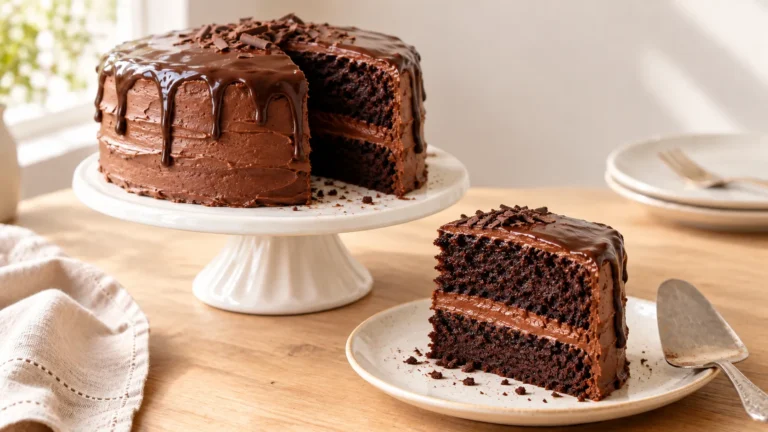
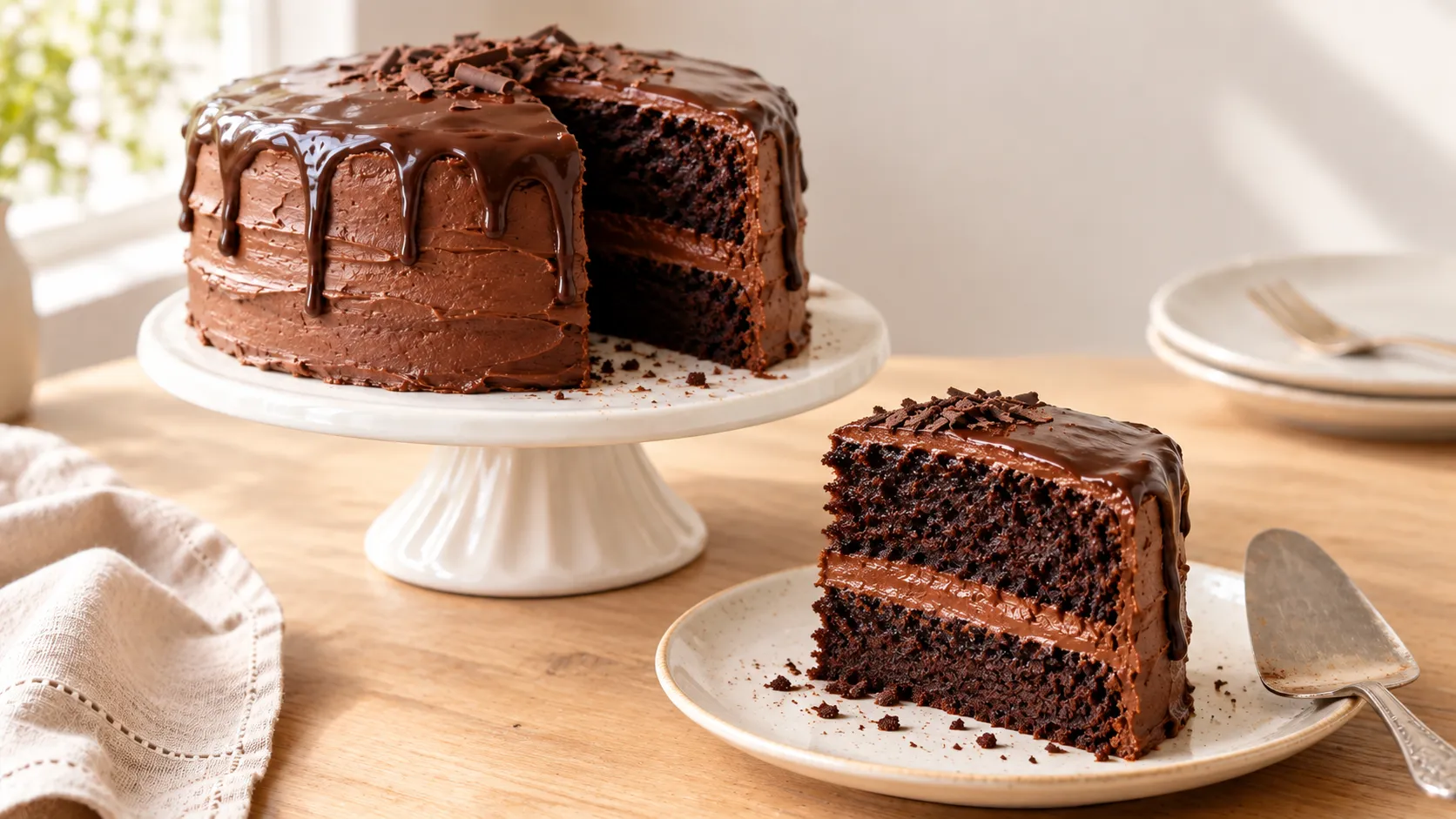
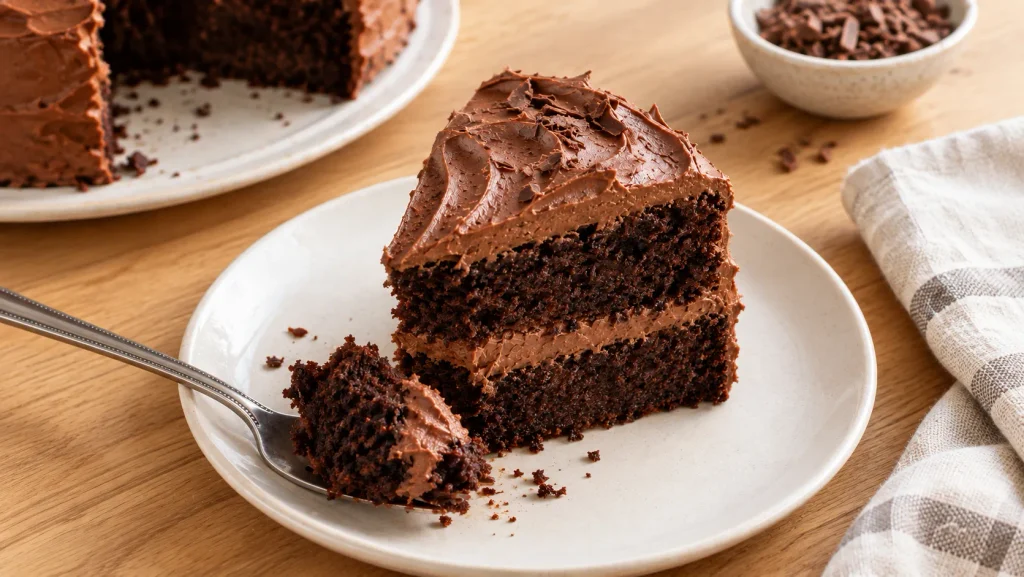
I’ve baked a lot of bad gluten-free cakes. Dry ones, gummy ones, one that sank so badly in the middle I filled the crater with frosting and called it a “chocolate bowl.” This gluten free chocolate cake recipe is the one that finally stopped all that. It’s dark, soft, and fudgy, and nobody at the table asks whether it’s gluten-free until you tell them.
It also happens to skip eggs and dairy, which mostly comes down to the way the recipe is built. Oil instead of butter, soured plant milk instead of buttermilk, and a lot of hot liquid. I’ll explain why each of those matters first, because once you know what’s going on in the bowl, a gluten-free chocolate cake gets a lot less mysterious. If you just want to bake, skip to the recipe. And if you’re in the mood for something other than chocolate, there are more gluten-free cake recipes to pick from.
The science behind a moist gluten-free chocolate cake
Wheat flour forgives a lot. Gluten builds a stretchy net that holds a cake together even when you overmix or overbake a little. Gluten-free flour blends are mostly rice flour and starches held together with xanthan gum, and they behave differently. They need more liquid, they dry out faster, and they punish guesswork. Three choices in this recipe do most of the heavy lifting.
Why oil beats plant butter here
Butter and plant butter blocks are roughly 80% fat and 15 to 20% water. Oil is all fat. That fat coats the starch granules and keeps the crumb soft for days, where a butter-based gluten-free cake tends to go dry and crumbly by the next afternoon.
A neutral oil like avocado, canola, or vegetable oil lets the cocoa do the talking. Unrefined coconut oil leaves a faint coconut note, which I happen to like with chocolate. A mild olive oil works too; its flavor mostly fades behind the cocoa once the cake cools.
Hot coffee and why the batter looks wrong
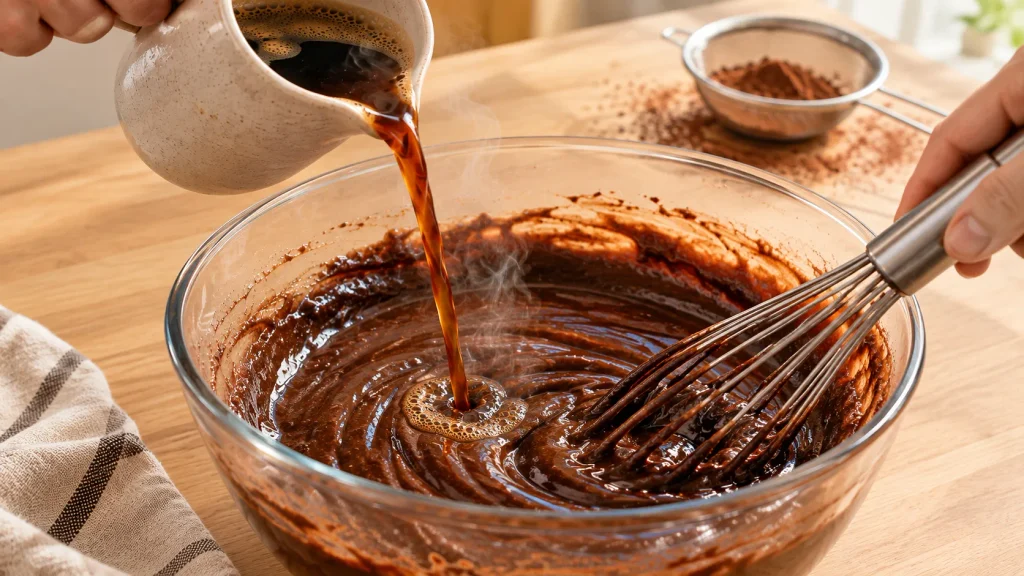
The last thing you add is a cup of hot coffee or boiling water. Hot liquid dissolves cocoa lumps and “blooms” the cocoa, which pulls out more chocolate flavor. It also gives the rice flour and starches the water they need to soften. You won’t taste coffee in the finished cake. It just tastes more like chocolate.
Here’s the part that scares people: the batter will be thin. Really thin, closer to chocolate milk than cake batter. That’s correct. Gluten-free starches soak up that liquid in the oven, and the extra hydration is exactly what keeps the crumb from turning dry or gummy. Don’t add more flour to “fix” it.
Getting the rise right without a collapse
Stirring a tablespoon of vinegar into soy or oat milk makes a quick dairy-free buttermilk. The acid reacts with baking soda the moment they meet, which gives the batter its first lift. That acid matters even more if you use Dutch-process cocoa, which is treated with alkali to neutralize its natural acidity and can’t wake up baking soda on its own. Baking powder keeps working in the oven and supports the rise until the structure sets.
The balance matters more than the amount. Too much acid or leavening makes the cake rise fast and then fall, leaving a sunken middle. So resist adding an extra splash of vinegar “for good measure.” Plain plant milk plus the measured vinegar gives you the most predictable cake.
Gluten-free flour guide: what works and what fails
The flour blend changes this cake more than anything else in the recipe. Whatever you buy, check that the bag says gluten-free. In the US, that claim means the food contains less than 20 parts per million of gluten under FDA labeling rules. I’ve baked this cake with the three blends below, and each one gives a slightly different result. (If you want to go deeper on blends, my fluffy gluten free pancake guide walks through five flour options.)
| Flour | Xanthan gum included? | What to expect |
|---|---|---|
| Bob’s Red Mill Gluten Free 1-to-1 (blue bag) | Yes | Thin batter, very moist and fudgy layers. My favorite for this cake. |
| King Arthur Measure for Measure | Yes | Slightly thicker batter and a fluffier, more delicate cake. It often needs a few extra minutes in the oven. |
| Doves Farm FREEE Plain Gluten Free Flour | No | Works well, but you have to add xanthan gum yourself. Follow the amount on the bag for cakes. |
A small tweak if your cake comes out gummy
Some 1:1 blends lean heavily on starch, and starch-heavy cakes can feel gummy. Swapping 30 to 40% of the blend for certified gluten-free oat flour fixes this. In practice that means 1 cup of your 1:1 blend plus 3/4 cup oat flour. The oat flour adds a little whole-grain flavor and a softer, less elastic crumb. One caution: a review of the research by Health Canada found most people with celiac disease can eat uncontaminated oats, but not everyone can. Skip this swap if you’re baking for someone who avoids oats.
If you’re working with a lighter or whole-grain blend that bakes up too crumbly, a tablespoon or two of tapioca starch adds some stretch and chew.
Flours you can’t swap in one-for-one
Almond flour, coconut flour, plain rice flour, and oat flour on its own won’t work as a straight swap. Each absorbs liquid at a completely different rate, and none of them can hold a cake together without a blend and a binder. Coconut flour is the worst offender. It drinks so much liquid that this cake would turn into a dense brick. If you want an almond flour chocolate cake, use a recipe written for it.
Egg replacers compared
In a cake without gluten, eggs usually do a lot of the binding. This chocolate cake doesn’t use them, so the egg replacer has to hold things together. Any of these works for the two eggs the recipe calls for.
| Replacer (for 2 eggs) | Amount | Result |
|---|---|---|
| Flax eggs | 2 tbsp ground flaxseed + 6 tbsp water, rested 10 minutes | Strong binding and a dense, fudgy crumb. My default. |
| Chia eggs | 2 tbsp ground chia + 6 tbsp water, rested 10 minutes | A good gel with no flavor you’ll notice. |
| Unsweetened applesauce | 1/2 cup | Extra moisture, decent binding, and you can’t taste it. |
| Mashed banana or avocado | 1/2 cup | Moist and a bit sweeter, with a faint fruity note. Banana is the more obvious of the two. |
Flax gives the most “brownie-like” texture, which is what I want from a chocolate cake. If you’d rather have something lighter and softer, applesauce is the better pick. And if banana is your thing, it does a lot more work in our gluten free banana bread.
The gluten free chocolate cake recipe
Prep time: 20 minutes. Bake time: 28 to 35 minutes. Makes two 8-inch round layers or one 9×13-inch sheet cake.
Ingredients
Weigh the flour if you can. Gluten-free blends vary a lot in weight per cup, so check your bag.
- 1 3/4 cups gluten-free 1:1 flour blend with xanthan gum (about 245 to 260 g). Or use 1 cup 1:1 blend plus 3/4 cup certified gluten-free oat flour.
- 3/4 cup unsweetened cocoa powder (about 70 g), Dutch-process if you have it
- 1 cup granulated sugar (200 g)
- 3/4 cup packed light brown sugar (150 g). The molasses in it keeps the cake moist.
- 1 1/2 teaspoons baking powder
- 1 teaspoon baking soda
- 1 teaspoon fine sea salt
- 1 cup unsweetened soy or oat milk (240 ml)
- 1 tablespoon white vinegar or apple cider vinegar
- 1/2 cup neutral oil (120 ml), such as avocado, canola, or melted refined coconut oil
- 2 flax or chia eggs, or 1/2 cup unsweetened applesauce
- 1 tablespoon pure vanilla extract
- 1 cup hot brewed coffee or boiling water (240 ml)
- Optional: 1 cup dark chocolate chips tossed in 2 teaspoons of the flour blend so they don’t sink
How to make it
- Prep the pans. Heat the oven to 350°F (175°C). Grease two 8-inch round pans, line the bottoms with parchment, and grease the parchment too. If you have fabric cake strips, soak them and wrap them around the pans. They keep the layers flat.
- Make the buttermilk. Stir the vinegar into the plant milk and leave it for 5 minutes. It will thicken and look slightly curdled.
- Sift the dry ingredients. Sift the flour, cocoa, both sugars, baking powder, baking soda, and salt into a large bowl. Cocoa clumps stubbornly, so don’t skip the sieve.
- Whisk the wet ingredients by hand. In another bowl, whisk the oil, soured milk, flax eggs, and vanilla. Leave the electric mixer in the cupboard. It beats in too much air, and that air is a common reason gluten-free cakes sink.
- Combine, then add the hot liquid. Pour the wet ingredients into the dry ones and whisk until no dry flour remains. Slowly pour in the hot coffee while whisking. The batter will be thin and pourable. That’s what you want.
- Bake. Divide the batter between the pans and bake for 28 to 35 minutes.
- Check early. Start testing at 28 minutes. A toothpick in the center should come out with moist crumbs clinging to it. Wet batter means it needs longer, but a perfectly clean toothpick means you’ve gone a little too far.
- Cool before frosting. Leave the layers in their pans on a wire rack for 10 to 15 minutes. Run a knife around the edges, turn them out, peel off the parchment, and let them cool completely. Frosting a warm gluten-free cake is how you get torn layers.
Troubleshooting common gluten-free cake problems
Most failures with this cake trace back to one of four things. Find your problem in the left column.
| Problem | Likely cause | Fix |
|---|---|---|
| Center sinks | Too much air from an electric mixer | Whisk the batter by hand. |
| Center sinks | Too much acid or leavening | Measure the vinegar and baking soda exactly. Don’t add extra. |
| Dry, crumbly texture | Overbaked | Pull the cake when the toothpick shows moist crumbs. |
| Dry, crumbly texture | Butter used instead of oil | Use a neutral liquid oil. |
| Gummy or heavy | Starch-heavy flour blend | Replace 30 to 40% of the blend with gluten-free oat flour. |
| Gummy or heavy | Too much flour from scooping | Weigh the flour, or spoon it into the cup and level it. |
| Sticks to the pan | No parchment | Line the pan bottoms with greased parchment rounds. |
If I had to pick one habit that saves the most cakes, it’s weighing the flour. A scooped cup of gluten-free flour can easily run 20% heavy, and that alone turns a fudgy cake into a gummy one.
Frosting, assembly, and storage
This chocolate cake is good enough to eat plain, but two layers of it with fudgy frosting is a proper celebration cake. Both frostings below stay dairy-free. Check that your chocolate is too, since some dark chocolate contains milk.
Fluffy chocolate buttercream
Beat 1 cup of room-temperature plant butter block (Country Crock Plant Butter and Stork both work) for 3 to 4 minutes, until pale. Sift in 3 cups of powdered sugar and 1/2 cup of cocoa powder a little at a time. Then beat in 1 teaspoon of vanilla, a pinch of salt, 8 oz of melted dark chocolate, and a splash of plant milk.
Let the melted chocolate cool to room temperature before it goes in. Warm chocolate melts the butter and you end up with chocolate soup. I learned this the hard way, twice.
Two-ingredient dark chocolate ganache
Heat 1 cup of full-fat canned coconut milk until steaming. Pour it over 8 oz of finely chopped 70 to 85% dark chocolate, wait one minute, then whisk until glossy. You can pour it straight over the cake or let it cool a bit and spoon it around the edge of a buttercream-frosted cake for drips.
Assembly and storage
Crumb coat first. Spread a very thin layer of frosting over the top and sides, then chill the cake for 20 minutes. This locks loose crumbs in place so your final layer goes on clean. Gluten-free cake is more crumbly than regular cake, so this step matters more here.
Wrapped well, the cake keeps for up to 3 days at room temperature, 5 days in the fridge, or 3 months in the freezer. Unfrosted layers freeze best. Bring refrigerated cake back to room temperature before serving, because cold gluten-free cake tastes dry even when it isn’t.
Frequently asked questions
Can I make this as cupcakes or a sheet cake?
Yes. For a 9×13-inch sheet cake, pour all the batter into one lined pan and bake for 30 to 35 minutes. For cupcakes, fill liners two-thirds full and bake at 350°F (175°C) for 15 to 18 minutes. You’ll get about two dozen.
Can I use regular all-purpose flour instead?
Yes. If you don’t need the cake to be gluten-free, swap in all-purpose wheat flour cup for cup and leave out any xanthan gum you would have added separately. The batter will still be thin, and the cake will be a little springier.
Will the cake taste like coffee?
No. The coffee makes the chocolate taste deeper and darker, but you won’t pick out a coffee flavor. If you’re avoiding caffeine, decaf or plain boiling water both work fine. Water gives a slightly milder chocolate flavor.
How do I stop the layers from doming?
Wrap damp fabric cake strips around the outside of the pans before baking. The edges heat more slowly, so the cake rises evenly instead of peaking in the middle. A sheet of wet folded paper towel wrapped in foil does the same job if you don’t own strips.
Is this the best gluten free recipe for chocolate cake for birthdays?
It’s the one I make for every birthday in our house, and the one I’d hand to anyone baking gluten-free for the first time. The batter is forgiving, the layers stack well, and it tastes like the chocolate cake you grew up with. Start with the buttercream, and save the ganache for when you want to show off. Planning a whole dessert table? These 13 easy gluten free dessert recipes pair well with it, and you’ll find even more in our gluten-free desserts collection.