
Table of Contents
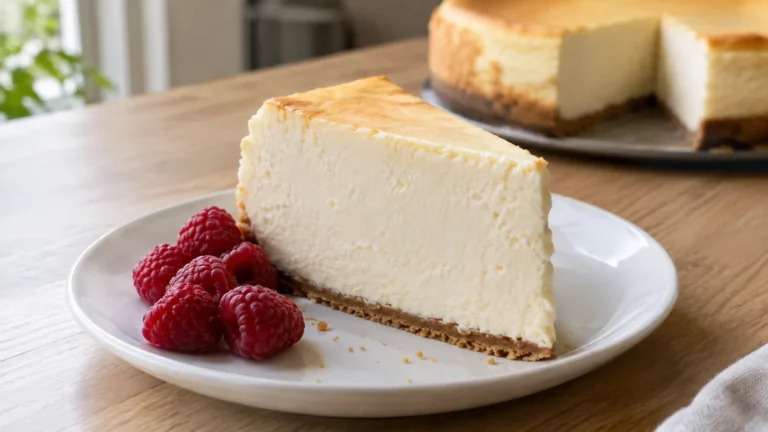
When the cheesecake craving hits and you’re gluten-free, you can’t exactly run out and grab a slice. Well, you can make one at home, and honestly it’s easier than you’d think!
Is cheesecake usually gluten-free? Nope. The filling is fine, it’s that graham cracker crust that’s the problem (and once in a while a recipe sneaks a little flour into the batter too). Swap those two things and you’ve got a gluten free cheesecake that tastes just like the regular kind, because it pretty much is the regular kind.
So this is my big cheesecake post. You’ll find the quick answer first, then all my tips for a crust that doesn’t crumble and a top that doesn’t crack, and then five different recipes: classic New York, Basque burnt cheesecake, no-bake, vegan and paleo, and keto. The full recipe card for the New York one is at the very bottom if you just want to get baking!
Quick answer: how to make a gluten free cheesecake
To make a gluten free cheesecake, use certified gluten-free graham cracker crumbs or finely ground nuts mixed with melted butter for the crust. Bring the cream cheese and eggs to room temperature, add 1 to 3 tablespoons of cornstarch or arrowroot to the filling, and let the cake cool slowly in the turned-off oven with the door cracked open.
That’s it in a nutshell! A few more things that are good to know before you start:
- The filling in a classic cheesecake is already gluten-free. It’s the crust you have to swap, and you’ll want to check the label on anything store-bought you add, like caramel sauce.
- Take the cream cheese out of the fridge 1 to 2 hours ahead. Cold cream cheese is the number one cause of lumpy batter.
- No water bath needed! There’s an easier way below.
- Cheesecake needs at least 4 hours in the fridge, and overnight is even better, so plan on making it the day before.
Gluten free cheesecake crust: how to make one that holds
Why gluten-free crusts crumble
Regular graham crackers have a little gluten in them, and that’s part of what holds the crumbs together. Gluten-free graham crackers don’t, so it’s really all up to the butter.
Too little butter and the crust falls apart when you go to cut a slice. Too much and it gets greasy and bakes up hard. For graham crumbs I go with about 5 tablespoons of melted butter for every 1 1/2 cups of crumbs. Mix it with a fork until it looks like wet sand, then grab a little and squeeze it. If it holds together, you’re good! If it crumbles, add another tablespoon of butter.
A bit of brown sugar helps too, since it melts in the oven and glues everything together. And nut crusts made with pecans or almond flour hold together really well because the nuts have their own oil.
Then just press it into the pan nice and firm. The flat bottom of a measuring cup or a glass works great for this. I only press my crust into the bottom of the pan, but if you like it going up the sides, make 1 1/2 times the crust. Bake it or freeze it before the filling goes in and you won’t have crumbly crust problems.
Crust comparison
| Crust | What goes in | How to make it hold | Best for |
|---|---|---|---|
| Classic GF graham | Certified gluten-free graham-style crumbs (Schär, Kinnikinnick and Pamela’s all make them), melted butter, sugar | Press firmly with a flat glass bottom and pre-bake 8 to 12 minutes | New York cheesecake, cheesecake bars |
| Pecan and almond brown sugar | Pecans, almond flour, light brown sugar, melted butter, sea salt | Pulse the nuts fine in a food processor, press, freeze 10 minutes before filling | No-bake and grain-free cheesecakes |
| Keto almond flour | Blanched almond flour, melted butter, powdered erythritol or allulose, salt | Pre-bake 10 minutes at 325°F (163°C), until just set | Low-carb and keto |
| Crustless (Basque) | None, only a double layer of parchment with an overhang | Press the parchment into a deep 8-inch springform so it holds the tall batter | Basque burnt cheesecake |
Can’t find gluten-free graham crackers near you? Crisp gluten-free cookies work too, like the cut-out version of my gluten-free sugar cookies. Just start with a tablespoon less butter since cookies already have butter in them.
If you’re baking for someone with celiac disease, look for crackers that say “certified gluten-free” on the box. “Wheat free” isn’t the same thing! In the US, a food labeled gluten-free has to have less than 20 parts per million of gluten under the FDA’s gluten-free labeling rule, and the Celiac Disease Foundation has lots more on gluten-free living and avoiding cross-contact at home.
The filling: starch, cream cheese and dairy-free bases
Why add starch to a gluten free cheesecake?
Cheesecake is really a custard, and the eggs are what make it set. If they get too hot though, they tighten up and squeeze out moisture, and that’s when you end up with a cracked top or a grainy texture.
A little bit of starch helps a lot here! Just 1 to 3 tablespoons of cornstarch, arrowroot or tapioca starch keeps the eggs from setting too hard, so the filling turns out smooth and it’s way less likely to crack. That’s why none of the baked recipes in this post need a water bath. (It can’t fix an oven that runs really hot though, so an oven thermometer is never a bad idea.)
All three starches are naturally gluten-free. If you’re baking for someone with celiac, I’d still buy one that’s labeled gluten-free, since starches are sometimes processed in the same facilities as wheat.
Choosing your base
Classic and New York style: Full-fat brick cream cheese (Philadelphia is what most people use), sour cream or crème fraîche, eggs, sugar, lemon juice and vanilla. Skip the spreadable tub kind. It has more water in it, so your cheesecake won’t set as firm.
No-bake: Cream cheese beaten with sweetened condensed milk and sour cream, then lightened up with whipped cream. Whip that cream all the way to stiff peaks because it’s what holds the whole thing up!
Vegan and paleo: Soaked raw cashews, coconut cream, maple syrup, arrowroot and a thick cultured coconut yogurt like Culina. The yogurt is what gives it that tangy cheesecake flavor, so don’t swap it for plain coconut cream.
Now let’s talk ingredients
Cornstarch: There’s only 2 tablespoons in the New York recipe but it really makes a difference. Don’t leave it out!
Cream cheese: Full-fat and softened.
Eggs: Room temperature eggs mix in smoothly, so you don’t have to beat the batter as long. I’d skip egg replacers in the baked versions because the eggs are what set the filling. If you need egg-free, go with the vegan cheesecake instead.
Sour cream: Full-fat again! It adds a little tang and keeps the cheesecake creamy. Crème fraîche works too.
Lemon juice: Fresh or bottled, either one is fine for just 2 teaspoons.
Gluten-free graham crackers: Any brand you can easily find near you or order online. Schär, Kinnikinnick and Pamela’s all make gluten-free graham-style crackers.
How to prevent cracks without a water bath
Steam pan vs. water bath
If you’ve never used one, a water bath is just a bigger pan of hot water that the cheesecake sits in while it bakes. It keeps things moist and helps stop cracks. The problem is you have to wrap your springform pan in foil, and water still has a way of sneaking in and making the crust soggy.
I like a steam pan better. Just set a 9×13-inch baking dish on the lowest rack of your oven and pour in 2 cups of boiling water. Then bake the cheesecake on the middle rack at 300°F to 325°F (150°C to 163°C). The steam keeps the oven nice and humid, and the cheesecake never touches the water!
The Basque cheesecake is the one exception. It’s baked really hot, at 400°F to 425°F (200°C to 220°C), so the top gets dark and caramelized while the middle stays soft and creamy. A few cracks are totally normal with this one.
Why cheesecakes crack (and how to stop it)
- Too much air in the batter. Cold cream cheese stays lumpy, so you end up beating it longer, and that whips in air. Those bubbles expand in the oven and crack the top. Take your cream cheese, eggs and sour cream out 1 to 2 hours before you start.
- Overmixing the eggs. Add them one at a time on low speed and stop as soon as each one is mixed in. Then tap the pan on the counter a few times to pop any bubbles.
- Overbaking. The cheesecake is done when the edges are set but a 2 to 3-inch circle in the middle still jiggles when you nudge the pan. It firms up the rest of the way as it cools.
- Sudden temperature changes. When it’s done, turn off the oven, prop the door open with a wooden spoon and let the cheesecake cool in there for 1 hour. After about 10 minutes, run a thin knife around the edge so it can shrink away from the pan without tearing in the middle.
Still got a crack? Don’t worry about it! It’ll taste just as good, and a spoonful of raspberry sauce or a pile of fresh berries covers it right up.
A few more tips
- Butter the bottom and sides of your springform pan so the cheesecake comes out easily.
- Make sure the oven is fully preheated, and try not to keep opening the door to check on it.
- Let the cheesecake come to room temperature on the counter before it goes in the fridge.
- Don’t try to take it out of the pan until it’s completely chilled.
5 gluten free cheesecake recipes
All five of these fit an 8 or 9-inch springform pan, and the baked ones follow the same basic steps (you’ll find them in the next section). If you’ve never made a gluten free cheesecake before, I’d start with the New York one!
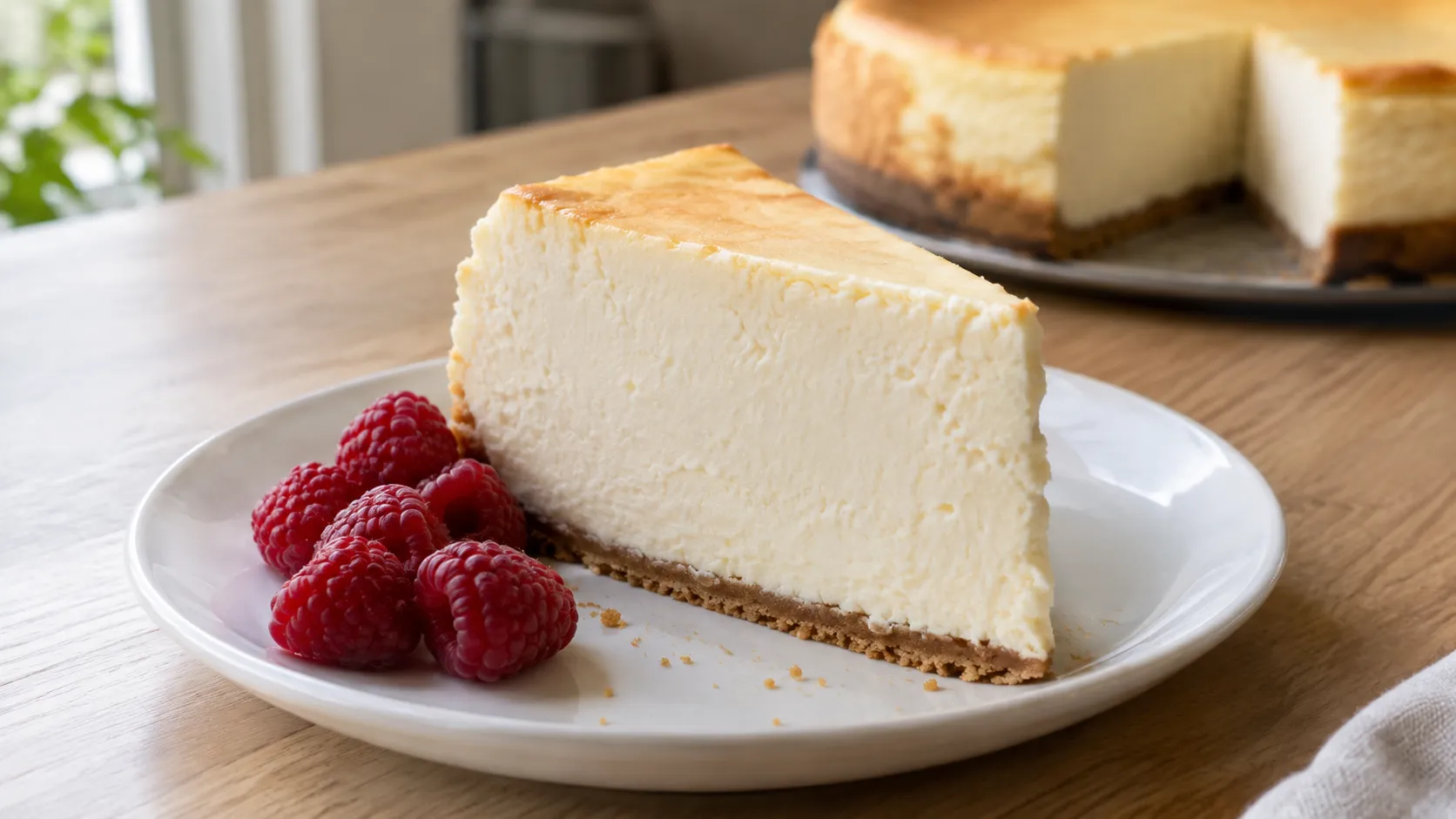
1. Classic New York gluten free cheesecake recipe
This is the tall, rich, creamy cheesecake everyone pictures. The sour cream gives it just a little tang so it’s not too sweet.
Crust: Mix 1 1/2 cups gluten-free graham crumbs with 5 tablespoons melted butter and 1 tablespoon sugar. Press it into a 9-inch springform pan and bake for 8 to 10 minutes at 325°F.
Filling:
- 32 oz (four 8-oz blocks) full-fat cream cheese
- 1 cup sugar
- 2 tablespoons cornstarch
- 4 eggs, room temperature
- 3/4 cup sour cream
- 1 teaspoon vanilla and 2 teaspoons lemon juice
Bake for 45 to 50 minutes at 325°F with the steam pan underneath. Then let it cool in the oven with the door propped open for 1 hour and chill it overnight. Every oven is a little different, so if the whole top still looks really jiggly at 50 minutes, give it 5 more minutes and check again. The full recipe is in the card at the bottom of the post.
2. Spanish Basque burnt cheesecake
This one is so easy! There’s no crust and no water bath, and you don’t have to worry about cracks at all.
Line a deep 8-inch springform pan with two sheets of parchment paper, pressing them in so the paper sticks up a couple inches above the rim. The batter puffs up a lot while it bakes and then sinks as it cools, so it needs the extra room.
Blend 700g full-fat cream cheese, 225g caster sugar, 1 teaspoon vanilla, 4 large eggs, 300ml sour cream, 25g cornstarch and 1/4 teaspoon salt until smooth. (These are UK large eggs, which are a little bigger than US large eggs, so use extra-large if you’re in the US.)
Bake for 10 minutes at 425°F (220°C), then turn the oven down to 410°F (210°C) and bake another 30 to 40 minutes, until the top is a deep dark brown. The middle will be really wobbly and look underdone, but that’s exactly what you want. Let it cool completely in the pan, which takes about 3 hours.
3. No-bake gluten free cheesecake
Great for summer when you don’t want to turn the oven on. You just have to be patient while it chills!
Crust: 3 3/4 cups gluten-free graham crumbs, 1 cup toasted pecans (pulsed until fine), 100g brown sugar, 141g (10 tablespoons) melted butter and a pinch of salt. That makes a thick crust, so press it into the bottom and up the sides of a 9-inch springform pan, then pop it in the freezer while you make the filling.
Filling: Beat 2 pounds cream cheese, 100g sugar, 80g sour cream, 76ml sweetened condensed milk and 1 tablespoon vanilla until smooth. Then gently fold in 160ml heavy cream whipped to stiff peaks.
Chill it overnight. After just 4 hours it’s still too soft to slice nicely.
4. Baked vegan and paleo cheesecake
This one is dairy-free and egg-free, plus grain-free, but it does have lots of nuts.
Crust: 1 1/3 cups pecans, 1 1/3 cups almond flour, 1/3 cup coconut sugar, 1/3 cup melted coconut oil, 1 teaspoon cinnamon and 1/2 teaspoon salt. Pulse the pecans until fine, mix everything together, press it into the pan and bake for 15 minutes at 350°F.
Filling: 1 1/2 cups raw cashews (soaked 4 hours in cold water, or 1 hour in just-boiled water), 3/4 cup coconut cream, 1 cup thick coconut yogurt, 1/3 cup maple syrup, 3 tablespoons lemon juice, 3 tablespoons arrowroot starch and 1 teaspoon vanilla.
Blend the filling for a good long while, until it feels completely smooth when you rub a little between your fingers. Then bake for 45 to 60 minutes at 325°F, until the edges are set and the middle barely jiggles, and chill it overnight. It firms up a lot in the fridge.
5. Keto sugar-free cheesecake
Each slice comes out to about 4g net carbs, depending on the brands you use and how big you cut your slices.
Crust: 1 1/2 cups almond flour, 1/4 cup melted butter, 2 tablespoons powdered erythritol and a pinch of salt. Bake for 10 minutes at 325°F.
Filling: 24 oz cream cheese, 3/4 cup powdered erythritol, 3 eggs, 1/2 cup sour cream, 1 teaspoon vanilla and 1 tablespoon lemon juice. Bake for 45 to 50 minutes at 325°F, then cool it slowly just like the others.
Make sure you use powdered erythritol, not granulated. Granulated doesn’t dissolve all the way in a thick batter, and you’ll end up with a gritty cheesecake.
Step by step: the basic method
Once you’ve made one baked gluten free cheesecake, the rest are easy since they all follow these same steps:
- Butter an 8 or 9-inch springform pan, or line the bottom with parchment paper.
- Make the crust. Pulse the crumbs or nuts, stir in the melted butter or oil, press it firmly into the pan and pre-bake or freeze it. (Keep the oven on!)
- Beat the softened cream cheese and sugar until smooth, scraping down the bowl a couple of times because lumps like to hide at the bottom. Then add the eggs one at a time on low, followed by the sour cream, starch and flavorings.
- Bake over the steam pan until the edges are set and the center still jiggles. Let it cool in the oven with the door propped open for 1 hour, then refrigerate for 4 to 24 hours.
- For pretty slices, dip a sharp knife in hot water and wipe it dry between each cut.
Topping ideas
The easiest topping is fresh berries and powdered sugar, and it looks so pretty! Just slice up some strawberries, add whatever other berries are fresh right now, and sprinkle powdered sugar over the top with a small sieve right before serving. (If you add the sugar too early it melts into the berries.)
Raspberry sauce: Simmer 200g raspberries with 1 tablespoon powdered sugar and a squeeze of lemon for about 5 minutes, until the berries break down. Push it through a sieve to get the seeds out and let it cool, then spoon it over the cheesecake and add a few whole raspberries on top.
Chocolate: Heat 1/2 cup heavy cream until it’s steaming, pour it over 4 oz chopped chocolate, wait 2 minutes and stir until it’s smooth and glossy. Let it cool until it’s thick but still pourable, then spread it over the chilled cheesecake. Most plain chocolate is gluten-free, but check the label, especially on chocolate chips.
Caramel and pecans: This one is rich, so thin slices are plenty! Drizzle about 1/3 cup caramel sauce over the chilled cheesecake and sprinkle 1/2 cup roasted chopped pecans on top. Some store-bought caramel sauces have barley malt in them, so check the label. You can also make the quick caramel from my caramel rice cakes post with just butter, brown sugar and cream. Double it for a whole cheesecake.
Troubleshooting and FAQ
Is cheesecake gluten free?
Usually not, and it’s all because of the crust. Traditional cheesecake sits on graham crackers or cookie crumbs made with wheat flour. The filling is normally fine on its own, but some older recipes add a couple of tablespoons of flour to the batter. Use cornstarch instead of that flour and a gluten-free crust, and you’ve got a gluten free cheesecake.
Why did my gluten free cheesecake crack?
Most of the time it’s from mixing too much after the eggs go in, baking a few minutes too long, or a big temperature change, like taking it straight from a hot oven to a cold counter. Check out the crack section above for how to avoid each one.
How long does gluten free cheesecake keep, and can I freeze it?
Keep it covered in the fridge for up to 5 days. It freezes really well too! Wrap slices or the whole cheesecake in plastic wrap and then foil, and freeze it for up to 2 to 3 months. Thaw it overnight in the fridge, not on the counter, and add any fruit toppings after it’s thawed.
Can I make gluten free cheesecake bars or mini cheesecakes?
Yes! For bars, line an 8×8-inch metal pan with parchment paper and leave some hanging over two sides, so you can lift the whole thing out later. Bake the crust for 8 minutes, pour in the filling and bake for about 30 minutes at 350°F (175°C). For mini cheesecakes, use a lined muffin tin and bake for 15 to 20 minutes at 300°F (150°C), until the tops look matte and only barely jiggle.
Does the Cheesecake Factory have gluten free cheesecake?
They have had a couple. Gluten-free options on the Cheesecake Factory menu have included the Godiva chocolate cheesecake and the Low-Licious cheesecake (plain or with strawberries). But the restaurant says its kitchens aren’t gluten-free or allergen-free, and those cheesecakes sit in the same display case as all the others, so if you have celiac disease that’s something to think about. Menus change too, so check the allergen guide on The Cheesecake Factory’s website before you go. Or just make one at home!
More gluten-free recipes to try
On a dessert kick? If you’re looking for more gluten free desserts, cheesecake is a great place to start, but there’s lots more on the blog. Try my gluten-free chocolate cake for another showstopper, check out the 13 easy gluten free dessert recipes roundup for quicker ideas, or browse all my cake, cookie and dessert recipes.
If you make one of these cheesecakes, leave a star rating in the recipe card below! I’d love to hear which version you made and any swaps that worked for you. And if you have a favorite topping that’s not on my list, share it in the comments.
Recipe card: Classic New York gluten free cheesecake
A tall, creamy New York style cheesecake on a buttery gluten-free graham crust, baked without a water bath.