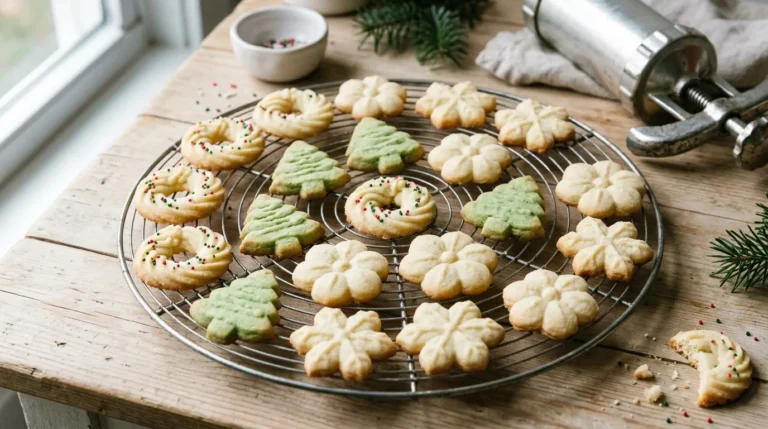

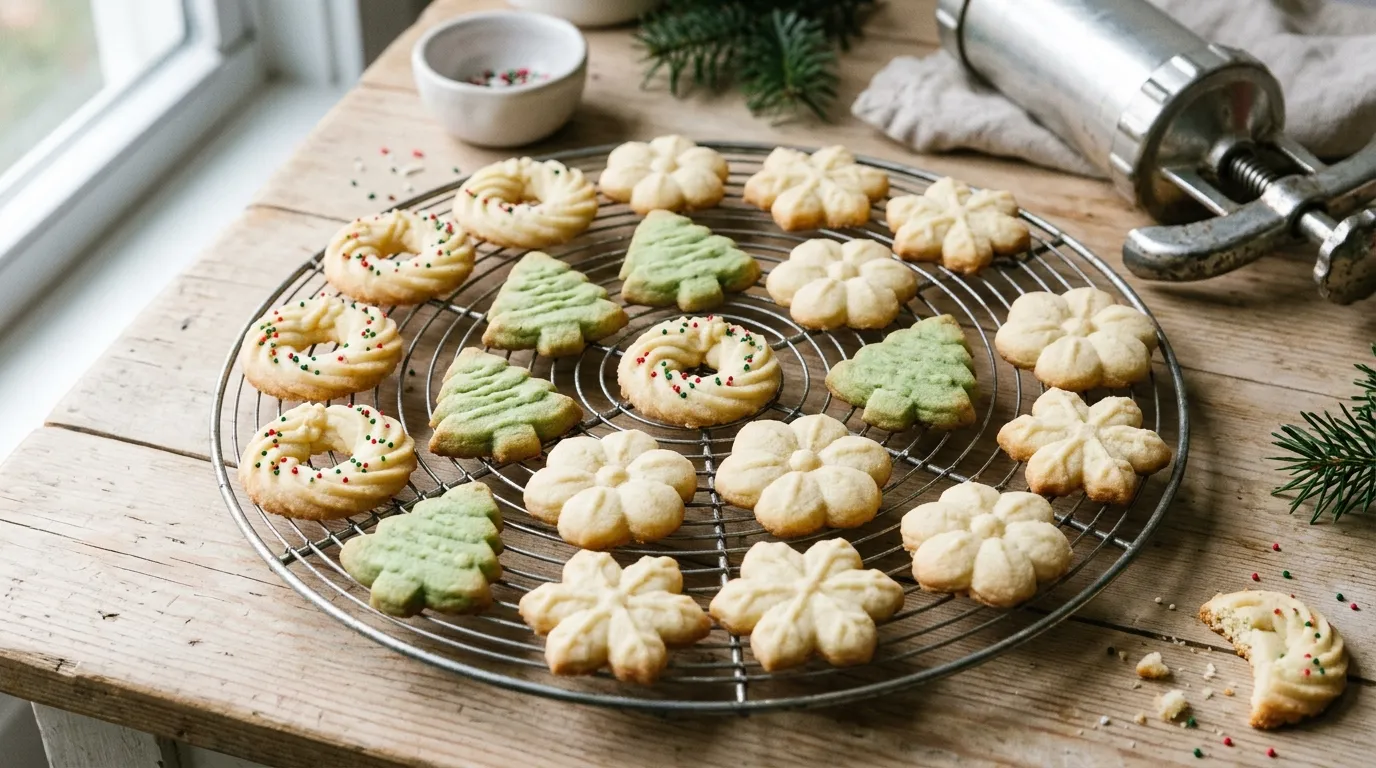
These gluten free spritz cookies taste like the ones from grandma’s cookie tin. They’re buttery, crisp at the edges, and they melt the second they hit your tongue. Most importantly, they actually hold their shape in the oven, which is more than I can say for my first few batches.
If you’ve ever swapped gluten-free flour into a regular spritz cookie recipe and gotten flat blobs (or dough that won’t leave the press), you’re not alone. Gluten-free dough can be fussy in a cookie press, so below you’ll find everything I learned the hard way: which flour works, what to press the cookies onto, and how to fix dough that refuses to come out.
Quick answer: Gluten free spritz cookies are classic butter cookies made with a gluten-free flour blend and shaped with a cookie press. This recipe makes about 60 small cookies in roughly 45 minutes. Use a measure-for-measure gluten-free flour that contains xanthan gum, press the dough onto a cool, bare baking sheet, and bake at 375°F (190°C) for 8 to 10 minutes.
What are spritz cookies?
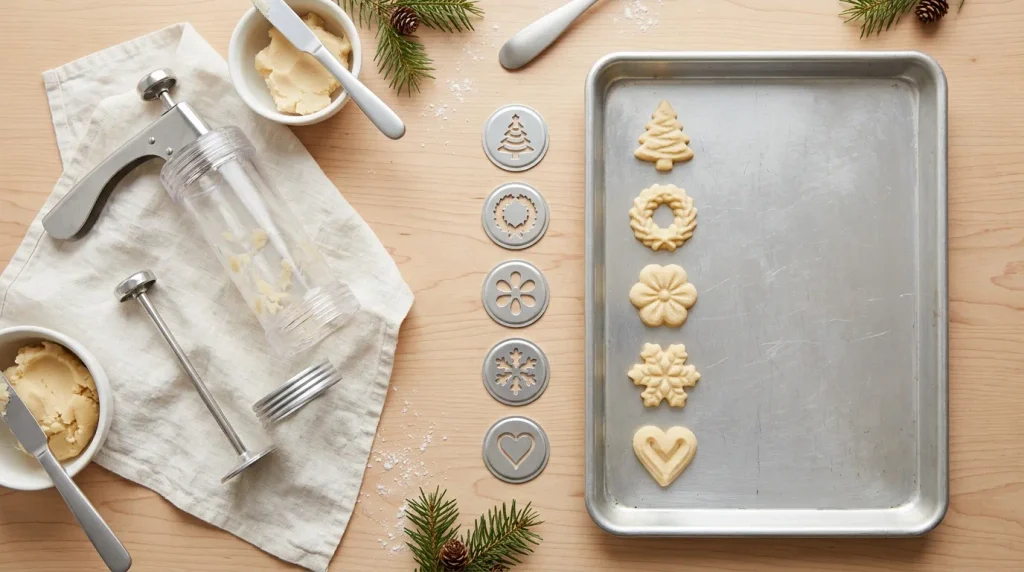
Spritz cookies are small butter cookies pushed through a cookie press into shapes like wreaths, trees, flowers and snowflakes. The name comes from the German word spritzen, which means “to squirt.” That’s pretty much what you do with the dough.
They’re a Christmas tradition in a lot of Scandinavian and German families, and in plenty of American ones too. (If you love old German holiday cookies, try my gluten-free springerle next. Those are stamped instead of pressed.) The dough has no baking powder or soda, so the cookies barely spread. Whatever shape you press is the shape you get.
Why this gluten free spritz cookie recipe works
A lot of gluten-free spritz recipes online are also dairy-free or vegan. That’s great if you need it. But if you just want the classic buttery cookie, without the gluten, there aren’t many good options. So that’s what this one is.
A few things make the difference. Real butter gives the flavor and the crisp, sandy texture. A gluten-free blend with xanthan gum holds the dough together so the ridges stay sharp. And a short 15-minute rest lets the rice flour soak up moisture, so the cookies don’t taste gritty. Skip it and you’ll notice a gritty bite.
The dough is soft enough to press without hurting your hands, but firm enough that a snowflake still looks like a snowflake after baking.
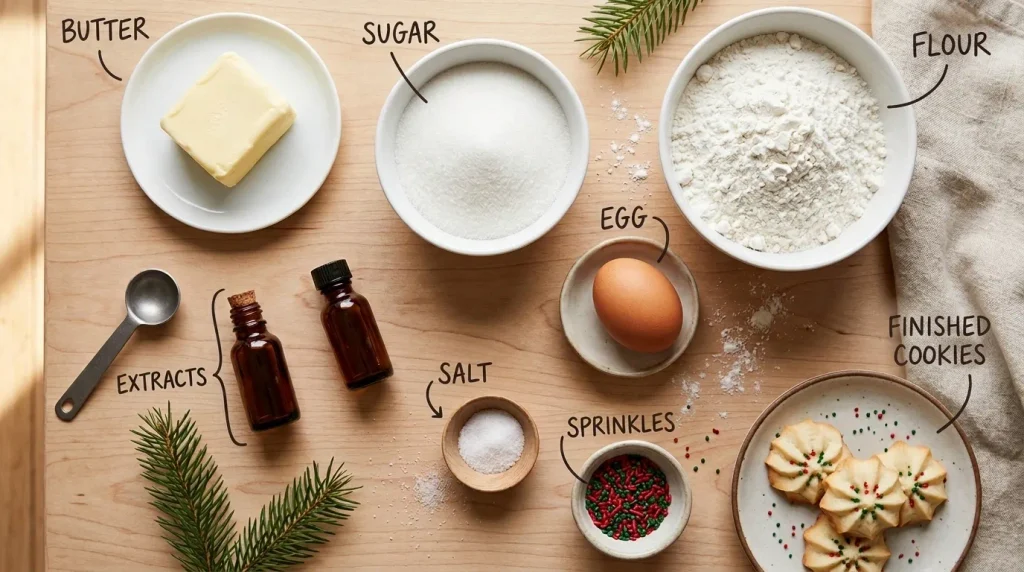
Ingredients for gluten free spritz cookies
You only need seven ingredients. The exact amounts are in the recipe card at the bottom of the post.
The best gluten-free flour for spritz cookies
The flour matters more than anything else here. Use a measure-for-measure (1:1) gluten-free blend that already has xanthan gum in it. King Arthur Measure for Measure and Bob’s Red Mill 1-to-1 both work well. If your blend doesn’t list xanthan gum, add 1 teaspoon.
I’d stay away from single flours like almond flour or coconut flour for this recipe. They make a dough that’s either too oily or too dry to go through the press.
| Flour blend | What to expect |
|---|---|
| King Arthur Measure for Measure | The best choice. The dough is smooth and soft, presses out cleanly, and the cookies keep sharp ridges. Crisp and buttery, with no grit after the 15-minute rest. |
| Bob’s Red Mill 1-to-1 | Works well too. The dough is a little stiffer, so you may need 1 to 2 teaspoons of milk. The cookies are slightly more tender and delicate while warm. |
| Almond flour only | Not recommended. The dough turns oily, sticks inside the press, and the cookies spread and lose their pattern in the oven. |
One more tip: weigh your flour if you can. Gluten-free blends pack differently, and too much flour is the number one reason dough gets stuck in the press.
Butter (and a dairy-free swap)
Use unsalted butter, soft enough that your finger leaves a dent but not greasy or melting. If you need these dairy-free, a firm vegan butter stick works. Skip the soft tub kind, because it makes the cookies spread. (Need a cookie that’s dairy-free from the start? My gluten free dairy free chocolate chip cookies are made for that.)
Egg, sugar, vanilla and almond extract
One room-temperature egg binds the dough. Plain white sugar keeps the cookies crisp. Vanilla is a must, and a little almond extract gives that old-fashioned bakery flavor. Check that your vanilla is labeled gluten-free.
Gluten-free sprinkles and food coloring
This is where gluten sneaks in. Some sprinkles contain wheat starch, so read the label every single time, even on brands you’ve bought before.
For colored dough, use gel coloring and only a few drops. Liquid coloring thins the dough, and then it won’t stick to the pan.
Choosing a spritz cookie press
You don’t need a fancy one. A basic press with a clear barrel and a handful of shape discs will do the job for years. A clear barrel helps because you can see how much dough is left.
Cookie press vs. cookie gun
They’re the same thing. “Cookie gun” is just another name for a cookie press, usually the trigger-style kind you squeeze like a caulking gun. The trigger style is easier on your hands and gives the same amount of dough with every click, which is why I prefer it. The older twist-style presses work too, but your wrist will feel it after five dozen cookies.
How to make gluten-free spritz cookies (step by step)
Here’s the whole process in plain steps. If you’ve been hunting for a spritz cookie recipe for a cookie press that works without gluten, this is the one. It’s easy once you’ve done it once, and your second batch will go twice as fast.
- Prep the oven and pans. Heat the oven to 375°F (190°C). Leave your baking sheets bare, no parchment and no grease, and put them somewhere cool.
- Cream the butter and sugar. Beat them for 2 to 3 minutes until pale and fluffy. Don’t rush this. The air you beat in now makes the cookies light.
- Add the egg and flavor. Beat in the egg, vanilla, almond extract and salt until smooth. Scrape the bowl once.
- Mix in the flour. Add the gluten-free flour on low speed and stop as soon as it disappears. The dough should feel soft, like play dough.
- Let it rest. Cover the bowl and leave it on the counter for 15 minutes. Not in the fridge. Cold dough won’t come out of the press.
- Fill the press. Roll a handful of dough into a log a little thinner than the barrel and slide it in. Pick your disc.
- Press the cookies. Hold the press straight up and down, flat against the sheet. Click once, then lift straight up. Space them about 1 inch (2.5 cm) apart.
- Decorate. Add sprinkles now, while the dough is still tacky, or they’ll roll right off.
- Bake. Bake one sheet at a time for 8 to 10 minutes, until the bottoms are just golden. The tops should stay pale.
- Cool. Leave them on the pan for 2 to 3 minutes, then move them to a rack. They’re fragile while warm and firm up as they cool.
How to use a cookie press for spritz cookies (beginner tips)
If you’ve never used a press before, the first few cookies might come out ugly. That’s normal. Scrape them back into the bowl and keep going. Any good spritz cookie press recipe needs a little practice, and these tips shorten it a lot.
- Start with a double click. On the very first cookie, click twice. It primes the press and leaves the end of the dough rough and tacky, which helps the next cookie grab the pan. Put that first blob back in the bowl.
- Keep the press flat. If you tilt it, one side of the cookie lifts off with the press.
- Lift fast and straight. A slow lift pulls the dough up with it.
- Less dough looks better. A thin, clean press gives sharper shapes than a big squeeze.
- Start with easy discs. Trees, wreaths and flowers are forgiving. Save the detailed snowflake for when you’ve got a feel for it.
Parchment, silicone mat or bare pan? Which works best
Use a bare, ungreased metal baking sheet. This is the one time in baking where you want the dough to stick to the pan, because that’s what pulls the cookie off the press.
You’ll see some gluten-free recipes that use parchment or a silicone mat, and that confused me at first. Here’s how the three surfaces compare:
| Surface | What happens |
|---|---|
| Bare, cool metal sheet | The winner. The dough grips the pan, the press lifts away cleanly, and every shape comes out sharp. |
| Silicone mat | Hit or miss. It works if the mat is cold, but some cookies lift off with the press, and the bottoms bake a little paler. |
| Parchment paper | The worst. The dough slides on the paper, so most cookies stay stuck to the press or come out lopsided. |
Whatever you use, keep the pan cool. A warm pan straight out of the oven makes the butter melt on contact, and the cookie slides instead of sticking. I rotate two or three sheets so one is always cooling.
Gluten-free spritz cookie troubleshooting
Something will probably go wrong at least once. It happens to everyone. Here’s how to fix the usual problems.
Why won’t my spritz cookies stick to the pan?
The pan is usually too warm, greased or lined. Press onto a bare metal sheet, and put it in the freezer for 5 minutes if your kitchen is warm. If the dough itself is too soft or thinned with food coloring, mix in a tablespoon of flour.
Why is the dough stuck in the cookie press?
The dough is either too cold or too stiff. If it came from the fridge, let it sit until it feels like soft play dough. If it’s dry and crumbly, you probably added too much flour. Beat in a teaspoon of milk at a time until it presses easily.
Why did my spritz cookies spread?
The butter was too warm, or the dough was too wet. Use butter that’s soft but still cool, and don’t add extra liquid coloring. Baking on a hot pan causes spreading too, so always start with a cool sheet.
Why are my gluten-free spritz cookies crumbly or gritty?
Gritty cookies mean the flour didn’t have time to absorb moisture. Let the dough rest for 15 minutes before pressing. Crumbly cookies usually mean too much flour or a blend without xanthan gum.
Can you make spritz cookies without a cookie press?
Yes. Spoon the dough into a sturdy piping bag with a large open star tip and pipe rosettes or little swirls. The dough is thick, so squeeze firmly and don’t use a thin disposable bag, because it can split.
No piping bag either? Roll the dough into 1-inch (2.5 cm) balls and flatten them gently with the bottom of a patterned glass. They won’t look like classic spritz, but they’ll taste exactly the same.
Flavor variations and decorating ideas
The basic dough is a blank canvas. These are the versions I come back to:
- Almond spritz: Use 1 teaspoon almond extract and cut the vanilla to 1 teaspoon. This is the old-fashioned flavor a lot of people grew up with.
- Chocolate-dipped: Dip half of each cooled cookie in melted chocolate and let it set on parchment. Check the chocolate label for gluten.
- Lemon or orange: Add the zest of one lemon or orange with the sugar. Bright and really nice next to all the heavy holiday sweets.
- Chocolate spritz: Swap 3 tablespoons (about 20 g) of the flour for cocoa powder.
- Holiday colors: Tint the dough green for trees and wreaths, or leave it plain and go wild with sprinkles. A few drops of gel coloring is enough.
Make it a regular spritz cookie recipe
Baking for a mixed crowd? This dough works as a classic spritz cookie recipe too, so you don’t need to hunt down a second one. Swap the gluten-free blend for the same amount of all-purpose flour and leave out any added xanthan gum. You can also skip the 15-minute rest, since regular flour doesn’t need time to soften.
Everything else stays the same: the bare pan, the cool sheets, the single click. Just remember to keep the two batches, and the press, completely separate if someone at the table has celiac disease. Even a little flour dust can be enough to make them sick. Wash the press and every disc well (or keep a second press just for gluten-free baking).
How to store and freeze spritz cookies
Spritz cookies keep really well, which makes them great for cookie boxes and gifts. They look so pretty tucked between gluten free sugar cookies and gluten free gingerbread cookies.
Baked cookies: Store them in an airtight tin at room temperature for up to 2 weeks. A metal tin keeps them crisper than a plastic box. To freeze, layer them with parchment in a freezer container for up to 3 months and thaw at room temperature.
Unbaked dough: Wrap it tightly and refrigerate for up to 3 days, or freeze for up to 3 months. Let it warm up on the counter until soft before you load the press. It won’t go through cold, no matter how hard you squeeze. Trust me.
FAQ
Do gluten-free spritz cookies need xanthan gum?
Yes. Without gluten, xanthan gum is what holds the dough together and keeps the pressed shapes sharp. Most 1:1 gluten-free blends already include it. If yours doesn’t, add 1 teaspoon to this recipe.
Can I use any spritz cookie recipe in a cookie press?
Most of them, as long as the dough has no baking powder or soda and it’s soft enough to squeeze. Leavening makes the cookies puff and blur the pattern, and stiff dough won’t come out at all. A good spritz press cookie recipe gives you a dough that feels like play dough at room temperature. This one does, and it’s made for gluten-free flour.
Can I make spritz cookie dough ahead of time?
Yes. Keep it wrapped in the fridge for up to 3 days or in the freezer for up to 3 months. Let it come back to room temperature before pressing, because cold dough is too stiff for the press.
Which gluten-free flour is best for spritz cookies?
A measure-for-measure blend with xanthan gum, like King Arthur Measure for Measure or Bob’s Red Mill 1-to-1. Avoid almond or coconut flour on their own, since they don’t make a dough that presses well.
How do I keep spritz cookies from spreading?
Use butter that’s soft but still cool, press onto a cool, bare baking sheet, and avoid liquid food coloring. Spritz dough has no baking powder, so if the dough is right, the cookies keep their shape.
More gluten-free cookies to try
Still baking? Browse all my gluten-free cookie recipes, or switch things up with soft, chewy gluten free peanut butter cookies. Need something for the dessert table too? These easy gluten free desserts have you covered.
If you make these spritz cookies, I’d love to hear how they turned out. Leave a rating in the recipe card, and tell me in the comments which disc you used!