
Table of Contents
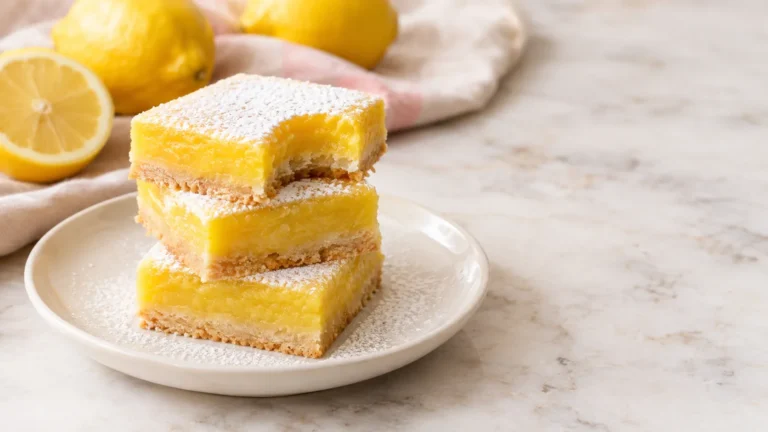
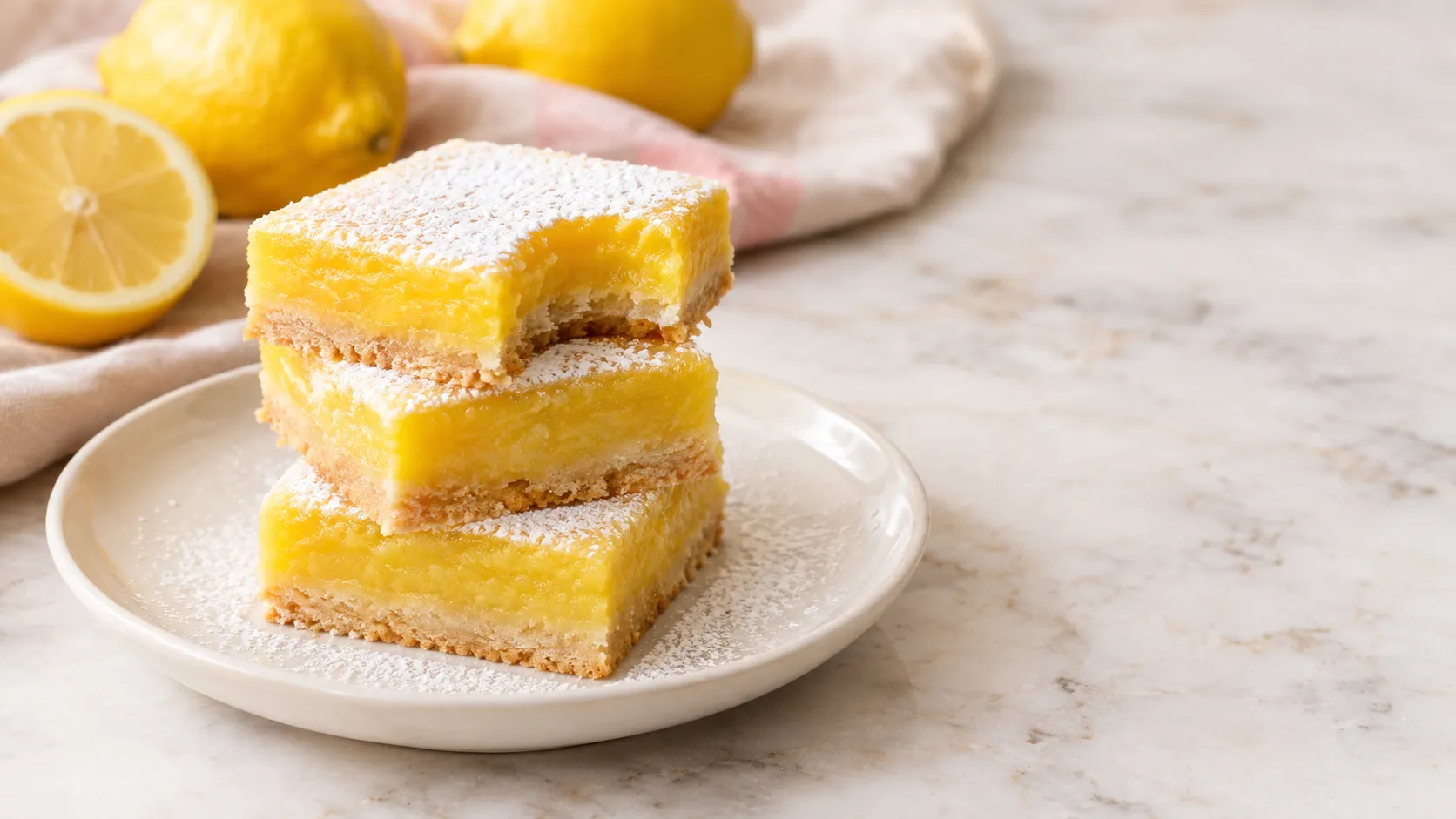
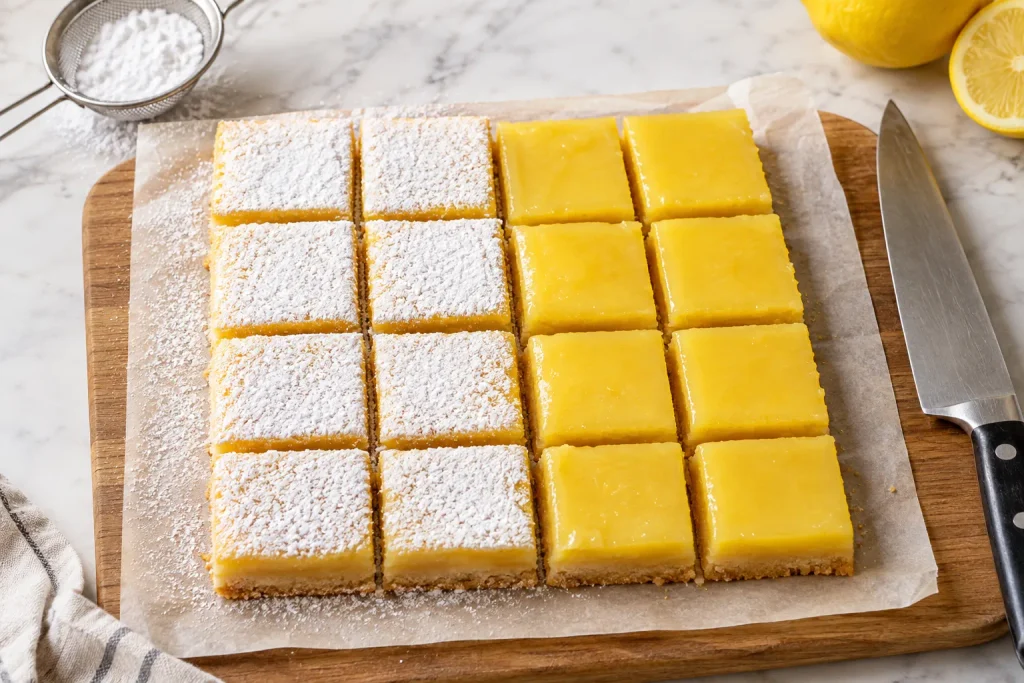
These gluten free lemon bars have a tall, tangy lemon layer that holds a clean edge when you slice it, sitting on a buttery shortbread crust that stays crisp. If you’ve been looking for a gluten free lemon bars recipe where the crust doesn’t go soggy (or float up through the filling!), this is it.
The filling is about twice as thick as the crust. There’s zest in both layers. And everything bakes in one 8×8-inch pan, no mixer needed.
Quick answer: For this gluten free lemon bars recipe, par-bake a shortbread crust made with a 1:1 gluten-free flour blend until light golden. Pour the strained lemon filling over the crust while it’s still warm, bake until the center barely wobbles, cool 1 hour, then chill at least 3 hours.Why this gluten free lemon bars recipe works
A lot of lemon bars are mostly crust with a thin skim of filling on top. I wanted the opposite: a thick, jiggly-then-firm lemon layer you can actually taste.
The ratio does most of the work in this gluten free lemon bars recipe. In an 8×8-inch pan, the crust comes out about 1/4 inch thick and the filling a little over 1/2 inch. That’s roughly 2:1. Pour the same filling into a 9×13 and it spreads so thin that it overbakes (and gets that rubbery, scrambled texture) before the crust is done.
Then there’s the lemon. Zest goes into the shortbread, so even the crust tastes bright. Fresh juice and more zest go into the filling. If you want to go all in, stir a teaspoon of zest into whipped cream for serving (totally optional).
The last piece is the crust itself. It gets baked until golden and firm before any filling touches it, and the filling goes on while that crust is still warm. That’s what keeps these easy gluten free lemon squares from going soggy or flipping upside down, which I’ll explain properly below because it’s the number one way lemon bars go wrong.
Gluten free lemon bars recipe ingredients and allergy swaps
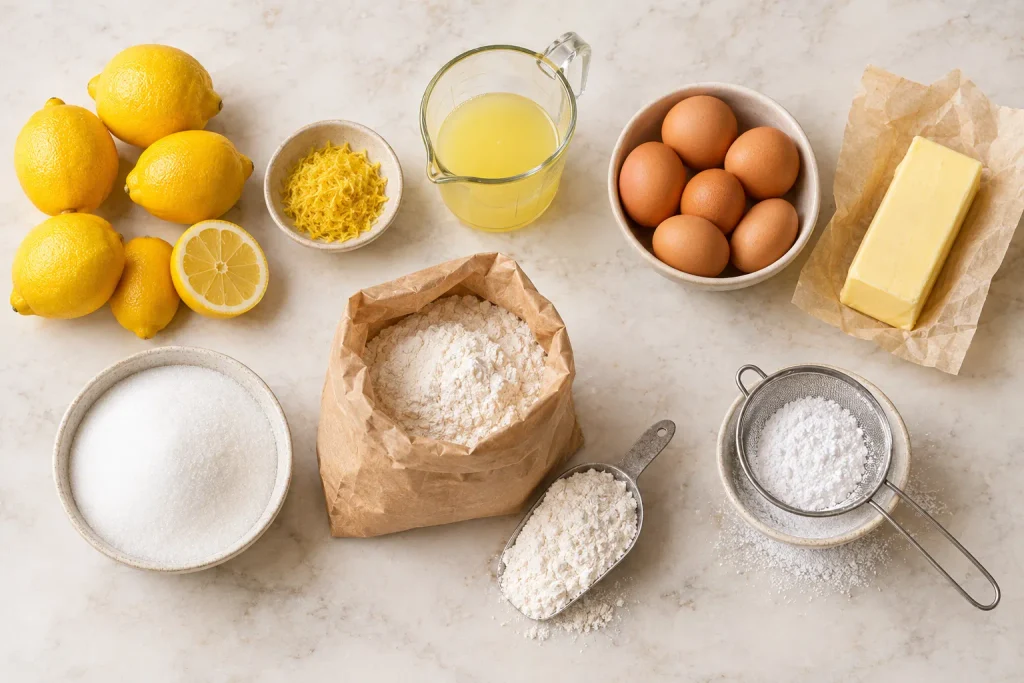
The ingredient list is short, so each one matters a little more than usual. Here’s what to know.
- 1:1 gluten-free flour blend: Use a cup-for-cup blend that already has xanthan gum in it. If yours doesn’t, add 1/4 teaspoon to the crust so it holds together when you slice.
- Butter: Unsalted and melted. Salted works too, just skip the added salt.
- Eggs: Four whole eggs plus two extra yolks. The yolks make the filling richer and less eggy-tasting, and they help it set firm enough to cut. Room temperature eggs whisk smoother, so pull them out about 30 minutes ahead.
- Lemons: Fresh only. You’ll need 4 to 5 lemons for 2/3 cup of juice. Zest them before you juice them (so much easier that way).
- Sugar: Granulated in both layers. Powdered sugar is just for dusting at the end. Most powdered sugar is gluten-free, but if you bake for someone with celiac, check the label for wheat starch, since not all wheat starch is gluten-free.
- Flour in the filling: A little of the same 1:1 blend helps the lemon layer set and slice cleanly. Arrowroot or tapioca starch work too.
Need to bake around another allergy? This table shows what to swap in each part of this gluten free lemon bars recipe. The grain-free and dairy-free columns are adaptations, so expect the texture to change a bit.
| Component | This recipe | Grain-free (almond flour) | Dairy-free / vegan |
|---|---|---|---|
| Crust flour | 1:1 gluten-free flour blend with xanthan gum | Almond flour plus a little coconut flour | Certified gluten-free oat flour plus almond flour and arrowroot |
| Fat | Unsalted butter, melted | Refined coconut oil (no coconut taste) | Plant butter sticks or refined coconut oil |
| Eggs | 4 eggs plus 2 yolks | 3 to 4 eggs plus yolks | Canned coconut milk set with cornstarch and agar (a different, stovetop filling) |
| Sweetener | Granulated sugar | Maple syrup or honey (darker color) | Cane sugar |
| Filling thickener | Gluten-free flour blend | Arrowroot or tapioca starch | Cornstarch or arrowroot |
For gluten free lemon bars with almond flour, keep the crust a little thicker and press it extra firmly, because nut crusts are more fragile. For dairy free gluten free lemon bars, plant butter sticks are the easiest swap since the filling has no dairy anyway. A fully vegan gluten free lemon bar needs an egg-free filling, which is really its own recipe.
How to keep lemon bar crust from getting soggy (and other common mistakes)
Quick answer: In any gluten free lemon bars recipe, the crust goes soggy when it’s under-baked and floats when the filling hits a cold crust. Bake the shortbread until golden and firm, pour the filling on while the crust is still warm, and strain the filling so it bakes smooth.
Why did my crust float to the top?
It sounds impossible, but it happens. When the crust cools completely, it shrinks slightly away from the pan. The thin liquid filling runs down the sides, slips underneath, and lifts the crust as it bakes. Fork holes in the crust give it another path in, especially with almond flour crusts.
The fix is timing. Have the filling ready before the crust comes out of the oven, then pour it on right away. Press the dough firmly into the corners, and don’t dock it with a fork.
Why is my crust soggy or gummy?
Under-baking. A pale crust is still soft inside, so it soaks up liquid during the second bake. Bake it 18 to 22 minutes, until the edges are golden and the center feels firm and dry when you touch it lightly.
Why are there white specks in my filling?
Those are bits of egg white that never got mixed in, and they cook into little white flecks. Whisk the eggs well (no streaks of clear white), then pour the finished filling through a fine-mesh sieve. Add the zest after straining so it doesn’t get caught.
And if your filling looks scrambled or rubbery, it baked too long. Pull it while the center still has a slight wobble. It keeps setting as it cools.
How to make this gluten free lemon bars recipe, step by step
The full amounts are in the recipe card below. These are the moments that make the difference.
Step 1: Par-bake the shortbread crust
Heat the oven to 350°F and line an 8×8-inch glass or ceramic pan with parchment, leaving extra hanging over two sides. Those flaps are your handles later.
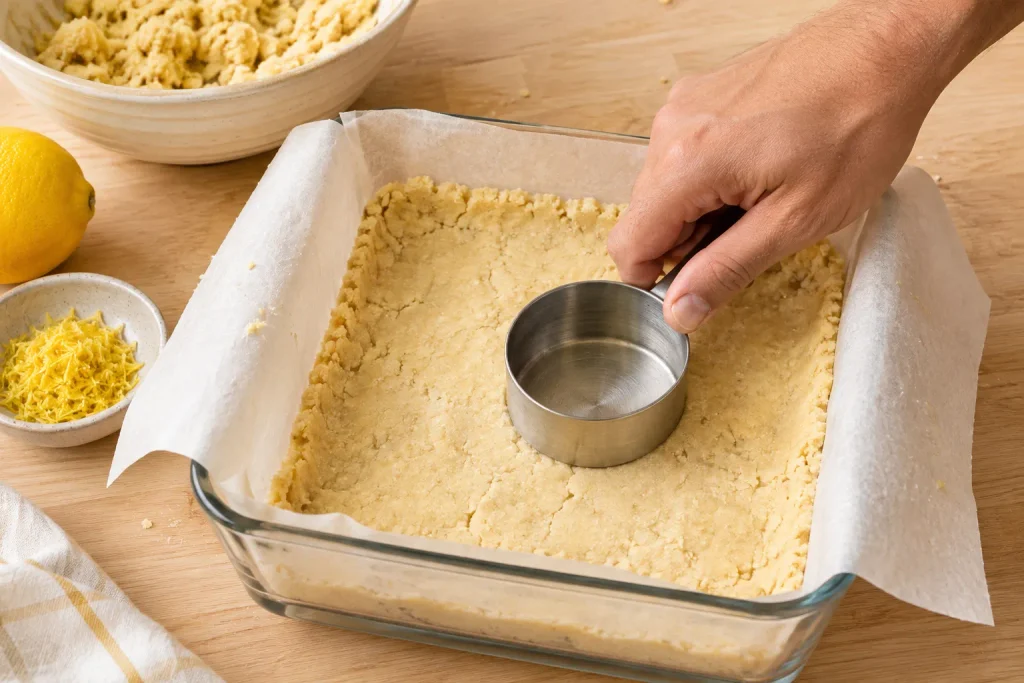
Whisk the melted butter, sugar, vanilla, salt and lemon zest, then stir in the flour blend. It’ll look like damp, crumbly sand. Dump it into the pan and press it flat with your fingers, then smooth it with the bottom of a measuring cup. Get it right into the corners.
Bake 18 to 22 minutes, until the edges are light golden.
Step 2: Whisk and strain the filling
Make this while the crust bakes. Whisk the sugar and flour together first (this stops the flour from clumping), then whisk in the eggs and yolks until there are no streaks of white. Add the lemon juice and whisk again.
Pour it through a fine-mesh sieve into a large measuring cup, then stir in the zest. Don’t whisk hard enough to make foam. Bubbles end up as a frothy layer on top.
Step 3: Pour onto the warm crust and bake
Take the crust out and pour the filling on right away. Drop the oven to 325°F and bake 24 to 30 minutes.
To check, give the side of the pan a gentle tap. The edges should be set and the center should wobble a little, like set gelatin, not ripple like liquid. Skip the toothpick test! Poking the top breaks the surface and can make it crack.
The best pan for lemon bars: glass, ceramic or metal?
For this gluten free lemon bars recipe, I reach for glass or ceramic. Lemon juice is acidic, and acid can react with bare aluminum, which leaves a faint metallic taste and sometimes a grayish tint where the filling touches the pan. Glass and ceramic don’t react at all. They also heat more gently, so the edges of the custard are less likely to overcook before the middle sets.
Metal is fine if it’s what you have. Line it completely with parchment (bottom and all four sides) so the filling never touches the metal. If the pan is dark, lower the oven by 25°F and start checking the crust a few minutes early, because dark metal browns the edges fast.
One more thing about glass: it takes longer to heat up, so a glass pan may need the full 22 minutes for the crust.
How to cut lemon bars cleanly
Quick answer: Cool lemon bars at room temperature for about 1 hour, then chill at least 3 hours. Lift the slab out with the parchment, cut with a long knife warmed under hot water and wiped dry, and clean the blade between cuts. Dust with powdered sugar just before serving.
Patience is the hard part of any gluten free lemon bars recipe. Let the pan cool on a wire rack for 45 minutes to 1 hour, then refrigerate for at least 3 hours. Overnight is even better. Warm lemon bars are soft all the way through and will smear no matter how good your knife is.
Once they’re cold:
- Lift the whole slab out by the parchment handles and set it on a cutting board.
- Run a long, sharp knife under hot water for about 10 seconds, then wipe it completely dry.
- Press straight down in one firm cut. Don’t saw back and forth.
- Wipe and rewarm the blade before every cut. Yes, every one.
Want bakery-style squares? Trim a thin strip (about 1/8 inch) off all four edges first. Cook’s snack.
When to put powdered sugar on lemon bars
Right before serving, through a fine-mesh sieve. If you dust them early, or while they’re warm, the sugar soaks into the moist top and disappears into a sticky glaze. The same goes for bars you’ve stored in the fridge overnight, so keep the sugar off until they’re on the plate.
Storing and freezing gluten free lemon bars
Keep them in the fridge, always. The filling is egg-based, so it shouldn’t sit out more than 2 hours. In an airtight container, bars from this gluten free lemon bars recipe keep 3 to 4 days, which is the window the FDA recommends for cooked egg dishes. Put a sheet of parchment between layers so the tops don’t stick together.
Can you freeze gluten free lemon bars? Yes, and they freeze really well.
- Chill the bars completely and skip the powdered sugar.
- Freeze the cut squares on a parchment-lined tray for about 1 hour, until firm.
- Wrap each one in plastic wrap and put them in a freezer bag. They’ll keep up to 3 months.
- Thaw overnight in the fridge, then dust with powdered sugar and serve.
The crust can soften a little after freezing, so if crispness matters most to you, serve them fresh.
Gluten free lemon bars recipe FAQ
Can I use bottled lemon juice instead of fresh?
I really don’t recommend it. Bottled juice tastes flatter and a little bitter next to fresh, and in a dessert that’s basically lemon, eggs and sugar, you’ll notice. Fresh lemons also give you the zest, which bottled juice can’t.
Why did my lemon bars turn brown on top?
Usually the oven ran a little hot, or they baked a few minutes too long and the sugar on the surface started to caramelize. Check them during the last 5 minutes, and use an oven thermometer if this keeps happening. A few light brown spots? Powdered sugar covers them completely.
Can I use maple syrup or honey instead of sugar?
You can, but expect changes. The filling will turn a deeper golden color instead of bright yellow, and you’ll taste the maple or honey. In the crust, a liquid sweetener makes the shortbread softer and less crisp, so a grain-free almond flour crust handles it better than a flour-blend one.
How do I make these nut-free?
This gluten free lemon bars recipe is already nut-free, as long as your 1:1 flour blend is nut-free (check the label, some include almond flour). If you need a grain-free and nut-free crust, sunflower seed flour can stand in for almond flour. Sunflower flour sometimes turns green when it reacts with baking soda or baking powder, but this crust has no leavener and the lemon filling is acidic, so it’s much less likely here.
Are regular lemon bars gluten-free?
No. The classic crust is made with all-purpose wheat flour, and most fillings use wheat flour too. That’s why both layers of this gluten free lemon bars recipe use a gluten-free blend.
More gluten-free bakes to try
If you’re on a lemon kick, browse more gluten-free desserts, or pair these with something from the gluten-free cookies page for a dessert tray. Looking for something for a birthday? The gluten-free cake recipes are over here.
If you make this gluten free lemon bars recipe, I’d love to know how they turned out. Leave a rating in the recipe card, and tell me in the comments if you tried the almond flour or dairy-free version.
Best gluten free lemon bars recipe card
This gluten free lemon bars recipe bakes a thick, tangy lemon filling on a crisp, zesty shortbread crust in an 8×8-inch pan.
Yield: 16 bars (2-inch squares) · Prep: 20 minutes · Cook: 50 minutes · Cool: 1 hour · Chill: 3 hours · Total: about 5 hours 10 minutes
Ingredients
For the crust
- 1/2 cup (113g) unsalted butter, melted
- 1/4 cup (50g) granulated sugar
- 1 teaspoon vanilla extract
- 1/4 teaspoon salt
- 1 teaspoon lemon zest
- 1 cup (about 140g) 1:1 gluten-free flour blend (add 1/4 teaspoon xanthan gum if your blend has none)
For the filling
- 1 1/3 cups (265g) granulated sugar
- 1/4 cup (about 35g) 1:1 gluten-free flour blend
- Pinch of salt
- 4 large eggs, room temperature
- 2 large egg yolks, room temperature
- 2/3 cup (160ml) fresh lemon juice (4 to 5 lemons)
- 1 tablespoon lemon zest
For serving
- Powdered sugar, for dusting
Instructions
- Heat the oven to 350°F. Line an 8×8-inch glass or ceramic pan with parchment, leaving an overhang on two sides.
- Whisk the melted butter, sugar, vanilla, salt and zest. Stir in the flour blend until it looks like damp sand.
- Press the dough firmly and evenly into the pan, including the corners. Don’t poke holes in it.
- Bake 18 to 22 minutes, until the edges are light golden and the center feels firm.
- While the crust bakes, whisk the sugar, flour and salt for the filling. Whisk in the eggs and yolks until no white streaks remain, then whisk in the lemon juice.
- Strain the filling through a fine-mesh sieve, then stir in the zest.
- Pour the filling onto the hot crust as soon as it comes out of the oven. Lower the oven to 325°F.
- Bake 24 to 30 minutes, until the edges are set and the center wobbles slightly when you tap the pan.
- Cool on a wire rack for 45 to 60 minutes, then refrigerate at least 3 hours or overnight.
- Lift out by the parchment, cut with a hot, dry knife (wipe between cuts), and dust with powdered sugar just before serving.
Notes
See the post for tips on preventing a soggy or floating crust.
Metal pan: line the bottom and all sides with parchment. For a dark pan, bake 25°F lower and check early.
Almond flour crust: see the substitution table above. Press it a little thicker and very firmly.
Dairy-free: use plant butter sticks in the crust. The filling is already dairy-free.
Storage: fridge up to 4 days, freezer up to 3 months (no powdered sugar). See the post for freezing steps.